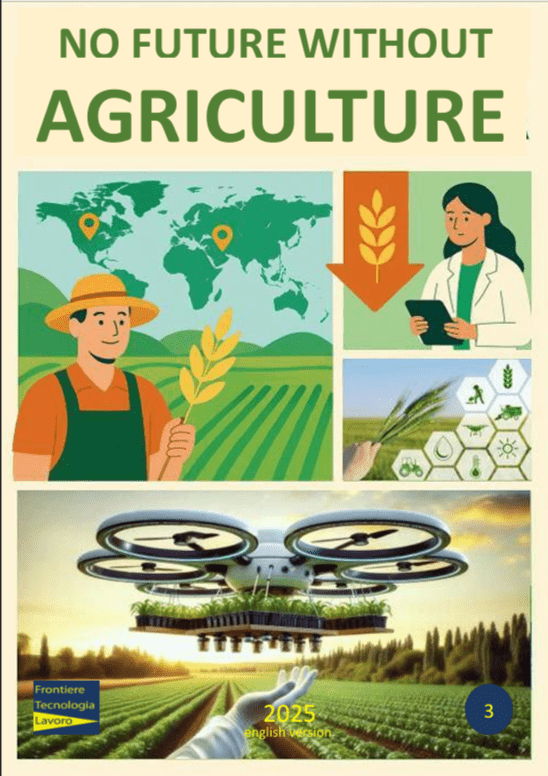
This comprehensive research study, titled “No Future Without Agriculture,” examines the technological transformation of the agricultural sector with specific focus on professional development and emerging skill requirements.
The investigation adopts a multidisciplinary approach to analyze the complex challenges facing contemporary agriculture, including global demographic growth, food insecurity affecting 733 million people worldwide, and climate change impacts on agricultural systems. The research explores how agriculture faces a dual strategic challenge: ensuring food security for an expanding global population while simultaneously reducing ecological impact of production systems.
The study aims to analyze technological transformations in agriculture, examining the emergence of precision agriculture, Agriculture 4.0 technologies, and innovative production models like vertical farming and regenerative agriculture. It investigates how digital technologies including IoT, artificial intelligence, drones, and sensors are revolutionizing traditional farming practices.
The research employs comprehensive data analysis covering global and Italian agricultural contexts, examining statistical trends, policy frameworks, and technological adoption patterns. It analyzes the Common Agricultural Policy 2023-2027 implications for the Italian agricultural sector, with particular attention to environmental sustainability and digitalization initiatives.
A significant portion investigates new professional profiles emerging in agriculture, including Agri Managers, Green Managers, IoT Specialists, Agricultural Data Analysts, and Climate Adaptation Technicians. The study examines how traditional farming roles are evolving into technology-integrated positions requiring multidisciplinary competencies.
The research explores enabling technologies of Agriculture 4.0, precision livestock farming, and robotic systems implementation in agricultural operations. It evaluates the economic viability and adoption challenges of innovative production systems, including vertical farming investments and urban agriculture implementations.
The investigation addresses regenerative agriculture principles, climate change mitigation strategies, and sustainable production methodologies. It examines how agricultural systems are adapting to environmental challenges while maintaining productivity and economic viability.
The study concludes with analysis of agricultural evolution prospects beyond 2040, exploring genetic engineering applications, alternative food sources, and the integration of traditional and innovative production models. It emphasizes the necessity for strategic planning, professional development, and technological infrastructure investment to support agricultural transformation.
There is no future without agriculture – But are we really sure?
Seguimi sui Social
Obiettivi
APPROFONDIMENTI
DIVULGAZIONE
NUOVI SCENARI DEL LAVORO
NUOVI LAVORI
NUOVE COMPETENZE