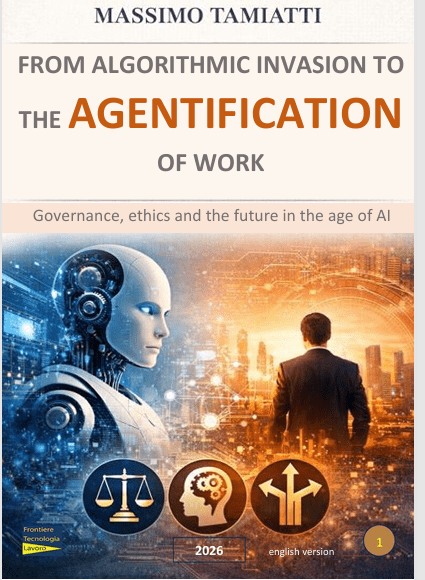
“The Agentification Of Work” is a 2026 essay (52 pages) examining the shift from reactive generative AI to autonomous AI agents and its consequences for work
The book starts from one observation: after the generative AI boom of 2022-2023, the new frontier consists of systems that do not merely respond, but perceive their environment, break down complex goals, plan and act without constant supervision. According to the McKinsey Global Survey 2025 cited in the text, 23% of organisations are already scaling agentic systems and a further 39% are experimenting with them, with estimated added value of between 2.6 and 4.4 trillion dollars per year
The essay develops three critical dimensions. The first is governance: the author proposes a Risk-Autonomy Matrix and three non-negotiable design principles (auditability by design, meaningful human control, the right to override), then tackles the legal liability puzzle through the categories of culpa in eligendo and culpa in vigilando, the European AI Act, and the prospect of strict liability in high-risk sectors
The second dimension concerns skills: the move from a “logic of doing” to a “logic of being”, with chapters on emerging professional profiles (AI Agent Orchestrator, Automated Process Validator, Algorithm Ethicist) and the argument for a “return of the philosophers”, in which hermeneutics, historical awareness and applied ethics become the new engineering. The text documents gender gaps in automation exposure (8.5% of female employment versus 3.9% of male employment in high-income countries, ILO data) and Italy’s position: potential GDP growth of 8% over ten years, yet only 7% of small and 15% of medium-sized firms currently run active AI projects.[
The third dimension sets out three scenarios for 2030: the collaborative ecosystem (“Centaur model”), the opaque network (“Black Box Society”) and digital feudalism. The conclusions argue for a “technological humanism”, urging readers to design agentification rather than passively endure it
The Agentification Of Work
Seguimi sui Social
Obiettivi
APPROFONDIMENTI
DIVULGAZIONE
NUOVI SCENARI DEL LAVORO
NUOVI LAVORI
NUOVE COMPETENZE