The publication argues that the relationship between human beings and digital technologies is no longer external but one of hybridization: we have become humanmachine “symbionts”, part of an informational planetary creature, and this reshapes identities, relationships, bodies and brains, generating both new opportunities and new vulnerabilities.
Hybridization and symbionts
The author begins from an autobiographical reflection: even those born in an analogue world now live in a hybrid condition, dependent every day on PCs, smartphones, platforms, digital assistants and social networks. This individual state is read as the outcome of a long history in which humans have constantly extended their bodies through tools, to the point of becoming biotechnological symbionts where the boundary between body and prosthesis is hard to trace.
The notion of symbiosis is thus expanded from biology to the intertwining of organisms with mechanical and electronic technologies, especially information technologies. In this framework, the widespread use of smartphones and alwayson connectivity turns almost every person into a cell of a global macroorganism, within an infosphere where online and offline blend.
Touchscreens, new communities and the “planetary creature”
The touchscreen is presented as a key interface that turns digital media into sensory extensions of touch, sight and hearing, redefining gestures and daily habits and creating a new “tactile literacy”. Around these devices a new planetary anthropological group emerges, multilingual and crosscutting, sharing common ways of interacting with screens and giving rise to a multitude of fluid, informal communities.
These online communities offer belonging, listening and room for experimentation, but they also contribute to blurring the line between natural and artificial and to the perception that those who remain outside this ecosystem become irrelevant. The network appears as a planetary envelope in which an emerging collective intelligence – and perhaps a collective consciousness – is driven by the desire for knowledge and connection.
Delegating to machines and virtual reality
A crucial step is the “delegation of the brain to machines”: from the symbiosis between humans and cars, we move towards autonomous systems and intelligent technologies that take over decisionmaking and cognitive functions once reserved for humans. Technological delegation reduces individual responsibility but weakens certain abilities, shifting tasks such as calculation, writing or memory storage onto devices.
Virtual reality further extends the body by cancelling distance and physical proximity: it enables intense experiences without movement, yet risks atrophying communicative skills rooted in bodily presence and contact with other living beings. The result is an imbalance between increased rationalcomputational power and an impoverishment of emotional, expressive and ethical dimensions.
Effects on the brain, overload and excessive use
The speed of technological evolution triggers a “biotechnological” evolution in which the biological component struggles to adapt to new, highly technologized symbionts. Information technologies promote multitasking, superficial scanning of information, distraction and cognitive overload, with consequences for working memory, attention quality and psychological wellbeing.
The studies referenced indicate links between intensive use of digital media and higher levels of anxiety, sleep disturbances, difficulties in deep comprehension of texts read on screens compared to print, and possible changes in somatosensory processing due to heavy touchscreen use. The touchscreen as such is not harmful, but excessive device use can cause physical strain and reduce the ability to concentrate and to relate directly facetoface.
Anthropological mutation and the role of humanism
The author interprets these processes as a genuine mutation of the species, in which technologies – especially tactile interfaces – stimulate the mind, senses and selfawareness, profoundly transforming identities and forms of sociality. The suffering associated with stress, permanent connectivity and emotional fragility is counterbalanced by new skills and opportunities, yet the overall assessment remains open and left to individuals.
To steer this transformation, a renewed humanism is needed, one that understands technology without demonizing or idolizing it and places the value of the human being back at the centre in a world where technological mediation dominates experience. Historians, philosophers and social scientists are called to work with engineers and innovators to interpret the ethical, social and political implications of new technologies and to safeguard human identity and dignity.
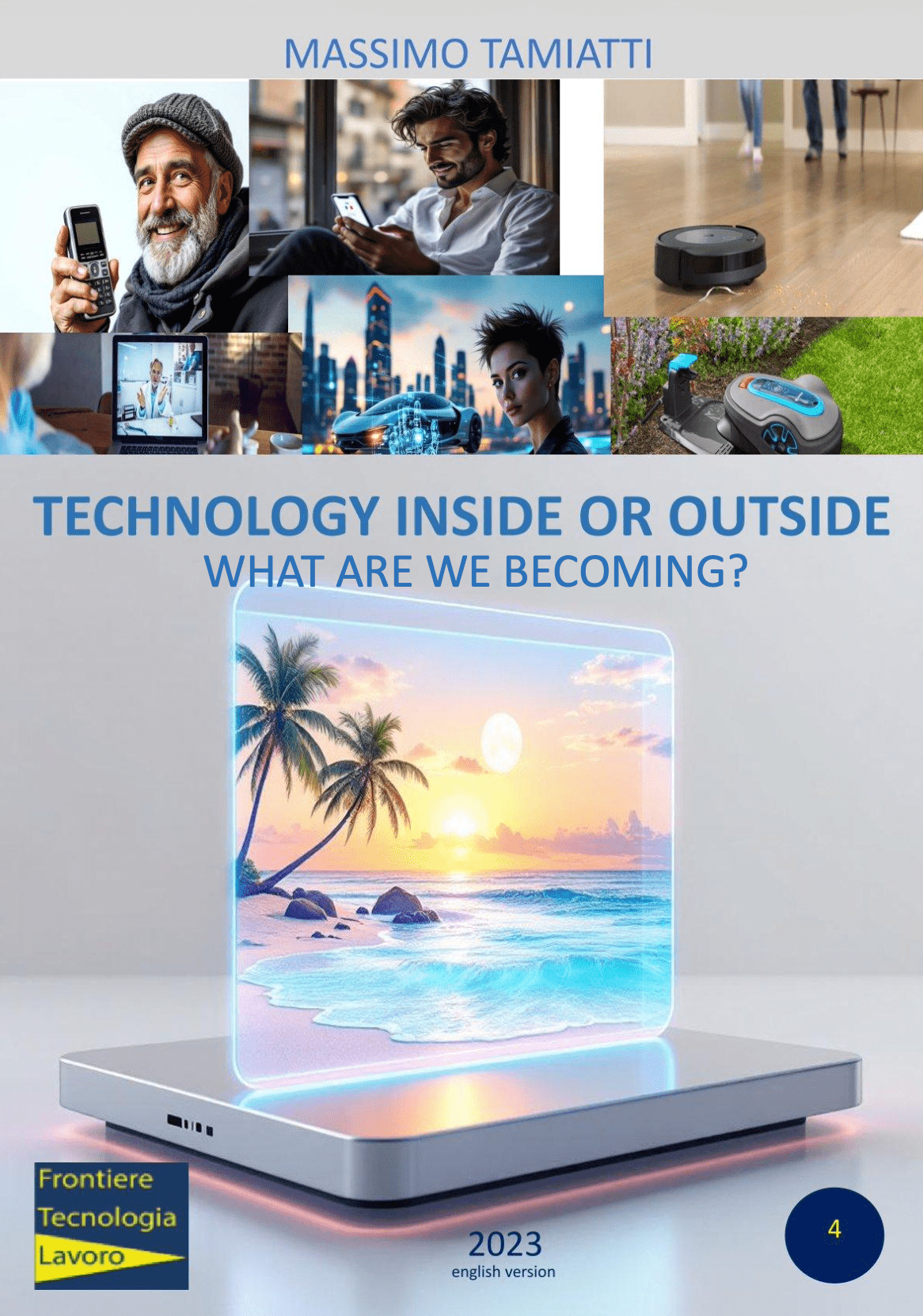
Techology: Inside or Outside? What Are We Becoming?
Seguimi sui Social
Obiettivi
APPROFONDIMENTI
DIVULGAZIONE
NUOVI SCENARI DEL LAVORO
NUOVI LAVORI
NUOVE COMPETENZE