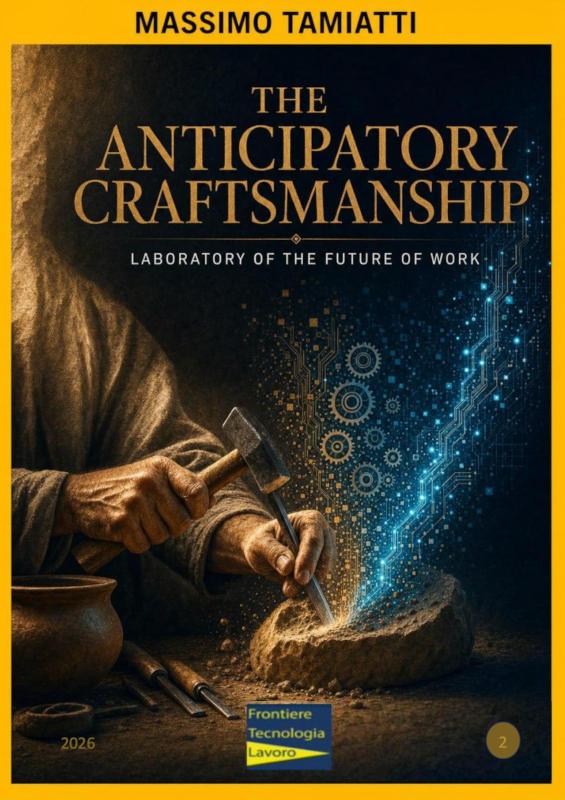
Italian craftsmanship should not be viewed as a sector in crisis, but as a living laboratory capable of anticipating the transformations destined to affect the entire production system between 2030 and 2035. The key message, therefore, is not “let’s save craftsmanship,” but rather “let’s learn from it” to transform the exception into the norm, also taking advantage of the renewed interest of young people, which has grown by 25% compared to 2022, reaching approximately 4 million potential interested parties.
The decade from 2025 to 2035 represents the critical window for intervention, made even narrower by a demographic trend that will remain irreversible until 2050-2060: today’s 25-year-old population is half as high as it was in 1969. The real issue, however, is not the lack of jobs, but the poor synchronization between supply and demand, generated by four mismatches: demographic, skills, cultural-narrative, and infrastructure. Addressing them requires three simultaneous interventions: enhanced training, with ITS (higher education institutions) scaling up from 20,000 to 200,000 students; a regional network of interconnected FabLabs; and a new cultural narrative that restores dignity and attractiveness to the role of the artisan.
Meanwhile, the sector is demonstrating three underlying dynamics that speak more of reinvention than decline: the historic increase in the number of employees overtaking the self-employed (50.3% versus 49.7%), the boom in artisan limited liability companies (from 5% to 8.7% in ten years, with 41,000 additional businesses), and the decline in sole proprietorships (-83,829) and partnerships (-63,969). At the heart of this transformation is the hybrid artisan, combining manual skill and advanced digital skills—CAD, CNC, 3D printing, augmented reality, and artificial intelligence—where green and digital become two sides of the same coin. Thus, new professions such as CNC carpenter, digital tailor, and 3D goldsmith are emerging, overcoming the Fordist paradox thanks to finally accessible mass customization.
Looking ahead to the next five to ten years, three scenarios emerge: the positive one of “widespread augmented artisans,” the dystopian one of “skills polarization” to be avoided, and the realistic and desirable one of “local collaborative ecosystems.” Four fundamental questions remain: how to scale up working models, how to convert youth interest into effective choices, how to maintain global competitiveness, and how to ensure an inclusive rather than selective transition. The final assessment combines urgent needs and hopes: on the one hand, irreversible demographics, disappearing skills, and limited time; on the other, an intact creative heritage, skills increasingly in demand by the system, and growing youth interest. The policy agenda concludes with concrete proposals—reducing bureaucracy and financial support, updating the Framework Law on Crafts, which dates back to 1985, reforming school guidance, expanding ITS Academies, tax incentives for apprenticeships and training, and local hubs with shared FabLabs.
Anticipatory craftsmanship
Seguimi sui Social
Obiettivi
APPROFONDIMENTI
DIVULGAZIONE
NUOVI SCENARI DEL LAVORO
NUOVI LAVORI
NUOVE COMPETENZE