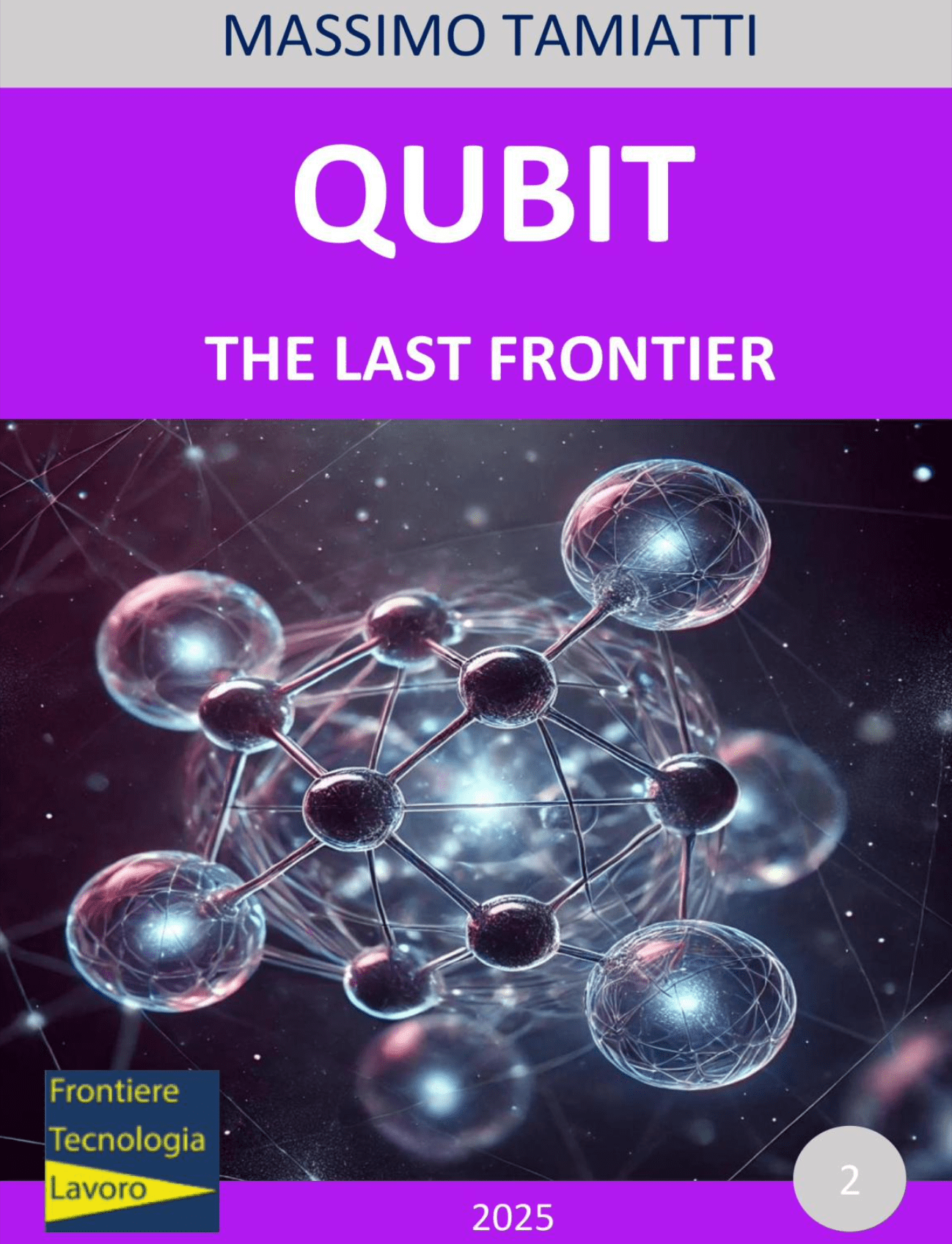
The investigation presented in the document “QUBIT – THE ULTIMATE FRONTIER” represents an in-depth and multidisciplinary analysis of the quantum revolution and its implications for contemporary society1.
The work is structured in 10 chapters that systematically explore the evolution of quantum computing, starting from a historical perspective of technological revolutions up to future prospects. The investigation begins with an introduction that frames the meaning of technological revolutions in human history, highlighting how each transformation has generated new professionalism and skills.
Technical Foundations and Current Developments
The central chapters (1-4) focus on technical foundations, analyzing the advent of quantum computing from 2016 to today, the physical principles of qubits (superposition, interference, entanglement), technological challenges such as quantum decoherence and the need for extreme cryogenic conditions1. Particular attention is dedicated to overcoming silicon limitations and transitioning to a new computational era.
Sectoral Impact and Geopolitical Dimensions
The second part of the investigation (chapters 5-6) examines sectoral impact and geopolitical dimensions, documenting how quantum computing is emerging in 303 industrial projects implemented by 203 companies, with investments exceeding $1.7 billion in 20211. The analysis highlights Chinese leadership with $15.3 billion invested, followed by the United States ($1.2 billion) and the European Union (€1 billion).
The most active sectors are:
- Financial (27% of investments)
- Chemical-pharmaceutical (21%)
- Automotive (12%)
- Energy (12%)
The investigation documents concrete applications such as fraud detection with quantum neural networks, molecular simulation for pharmaceutical development, and energy grid optimization1.
Ethical and Social Implications
The third section (chapters 7-8) addresses ethical and social implications, examining issues of equity in technology access, privacy and surveillance, in addition to market prospects with growth forecasts up to 1-2 trillion dollars by 2035.
Emerging Professions and Future Workforce
Chapter 9 focuses on emerging new professions, with projections of 250,000 specialized jobs by 2030 and 840,000 by 20351. The investigation identifies key figures such as quantum engineers, quantum physicists, quantum software developers, and quantum business strategists.
Future Perspectives
The final chapter explores future prospects, suggesting we are entering a “second quantum revolution” that manipulates single quantum particles, differently from the first that exploited collective behaviors1. The analysis highlights how quantum technology could transform personalized medicine, artificial intelligence, and cybersecurity.
Conclusions
The investigation concludes that, despite current technical challenges (NISQ systems still imperfect, need for millions of qubits for fault-tolerant applications), the quantum revolution represents a fundamental paradigm shift that requires educational, cultural, and strategic rethinking1. The document emphasizes the importance of developing interdisciplinary skills and hybrid approaches that combine classical and quantum technologies to address the challenges of the 21st century.